
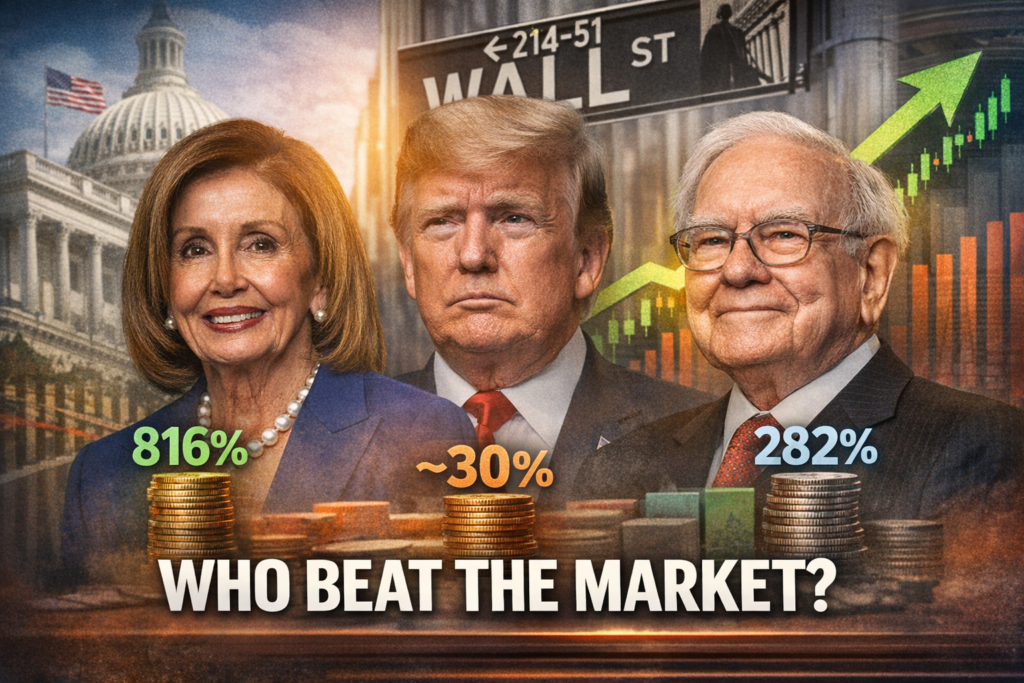
Set this post’s Featured Image in WordPress Media Library to: markets-and-power-featured.png (1200×675).
Should Lawmakers Be Allowed to Beat the Market They Regulate?
Legality is not the same as legitimacy. The central question raised by congressional investing is not whether a specific trade can be proven criminal—it is whether the rules produce a system citizens can reasonably trust.
The Legal Baseline
Members of Congress may hold and trade financial assets, subject to disclosure requirements and laws prohibiting insider trading. The gray zone is that many advantages in politics are structural rather than transactional: access to priorities, policy direction, and timing can exist without a single “insider tip.”
The Pelosi Question
The Pelosi household is frequently cited because the returns are widely described as unusually strong and because the household’s investing activity is discussed alongside periods of high legislative influence. Even if every trade is lawful, the optics are troubling: when lawmakers can influence budgets, regulation, and industrial policy, personal exposure to those outcomes looks like a conflict of interest.
Why Buffett Matters Here
Buffett is relevant not because he is the only benchmark, but because he demonstrates that extraordinary returns can be earned without political proximity. That makes a simple ethical point: if markets are meant to be fair, political power should not function like an investable advantage.
Trump, Crypto, and a Different Ethical Risk
Trump’s activity around media and crypto highlights a separate problem: when politicians become sponsors or promoters of assets that can be affected by policy, the risk is future favoritism and eroded credibility. Even if nothing improper occurs, the perception of policy‑for‑profit can damage trust in institutions.1
Policy Reform Options
- Blind trusts for senior lawmakers and executive officials
- Restrictions on individual stock trading (permitting diversified funds/ETFs only)
- Shorter disclosure windows and standardized reporting that reduces ambiguity
- Independent enforcement with real penalties for noncompliance
Conclusion
This is not a partisan issue. It is a governance issue. Markets rely on trust; democracies rely on legitimacy. When citizens believe lawmakers can profit from decisions they control, both systems weaken.
Footnotes
- Crypto policy and enforcement spans multiple agencies and administrations; ethical risk arises when policymakers have direct exposure to policy outcomes. ↩