
Waking Up: A Guide to Spirituality Without Religion — Sam Harris
Framing Question
Is it possible to experience spiritual depth without believing anything false?
This is the wager at the heart of Waking Up. Sam Harris is not attempting to rescue religion, nor dismiss spirituality as delusion. He is attempting something more ambitious: to separate mystical experience from religious belief, and to argue that one can survive—perhaps even flourish—without the other.
The Core Thesis
Harris’ central claim is both simple and radical:
Spiritual experiences are real psychological events, but religious doctrines are unnecessary—and often harmful—interpretations of those events.
Consciousness, he argues, can be explored directly through meditation, disciplined attention, and altered states without metaphysical commitments to gods, souls, or dogma. The self, upon inspection, dissolves.
This is not a book about belief. It is a book about attention.
Why This Book Matters Now
Waking Up sits at the intersection of three modern failures:
- The collapse of religious authority
- The rise of therapeutic, consumer spirituality
- A culture addicted to distraction
Many people have lost faith in religion but still feel that something essential is missing. Harris offers a solution: keep the experience, discard the stories.
Argument Map
- The sense of self feels real
- Close attention reveals it is constructed
- Meditation exposes this illusion
- Seeing clearly produces psychological freedom
- Religion adds unnecessary mythology
Where Harris Is Right
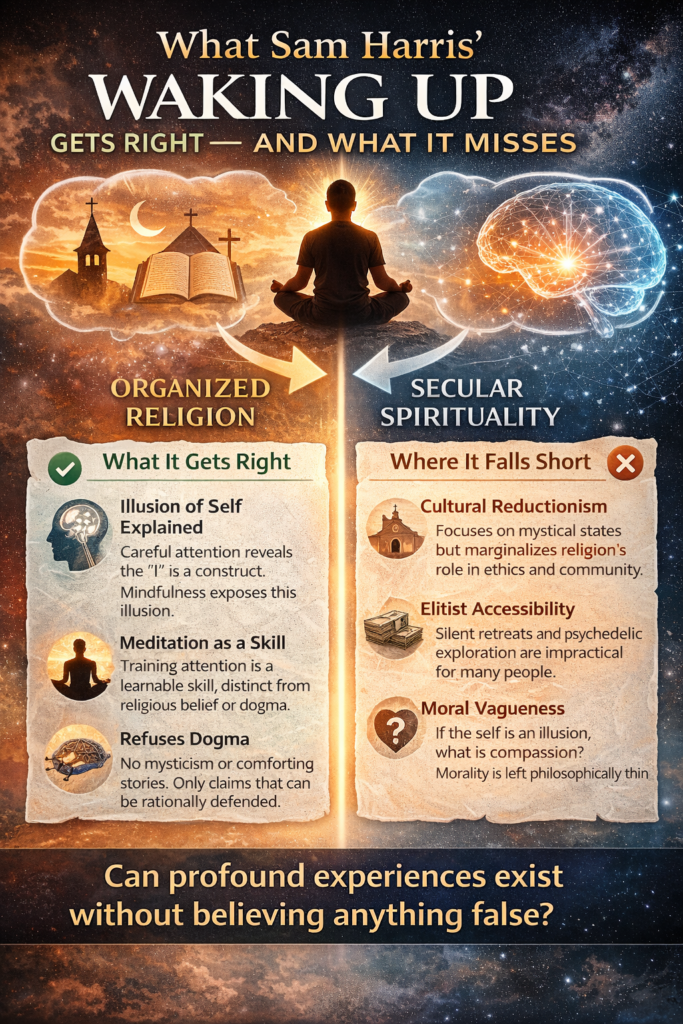
1. The Illusion of the Self
The book’s strongest chapters dismantle the intuition that there is a stable “I” behind experience. Drawing from neuroscience and Buddhist practice, Harris shows the self to be a narrative overlay—useful, but not fundamental.
2. Intellectual Honesty
Unlike most spiritual writers, Harris refuses to soften conclusions for comfort. If something cannot be defended rationally, it is discarded.
3. Meditation as a Skill
Meditation is treated as trainable attention, not moral virtue or spiritual identity. This alone distinguishes the book from most mindfulness literature.
Where the Book Is Weak
1. Cultural Reductionism
Religious traditions are often treated as mere delivery systems for mystical states, minimizing their ethical and communal roles.
2. Elitist Accessibility
The path Harris outlines—silent retreats, disciplined introspection, altered states—is not equally accessible to all.
3. Moral Underspecification
If the self is an illusion, why should obligation or responsibility survive? Harris gestures toward compassion, but does not fully ground it.
Comparative Context
| Thinker | Agreement | Disagreement |
|---|---|---|
| Buddhism | No-self, mindfulness | Metaphysics removed |
| William James | Mystical experience | Pluralism rejected |
| Nietzsche | God is dead | Harris still seeks transcendence |
Who Should Read This Book
Read it if you:
- Are skeptical of religion but drawn to meditation
- Value clarity over comfort
- Want spirituality without superstition
Avoid it if you:
- See religion primarily as communal or moral infrastructure
- Prefer poetry to precision
Verdict
Waking Up is not a comforting book. It is a clarifying one.
Harris succeeds in carving out a narrow but defensible territory: a spirituality grounded in experience, stripped of belief, and disciplined by reason. Whether this is sufficient to sustain meaning over a lifetime remains an open question—but the experiment is worth engaging.
This is not a book that tells you what to believe. It tells you where to look.
FAQ
What is Waking Up about?
A rational exploration of spirituality, meditation, and consciousness without religious belief.
Is Waking Up anti-religion?
It is critical of religious doctrine, but sympathetic to mystical experience.
Is the book worth reading?
Yes—especially for readers interested in mindfulness, philosophy of mind, and secular ethics.